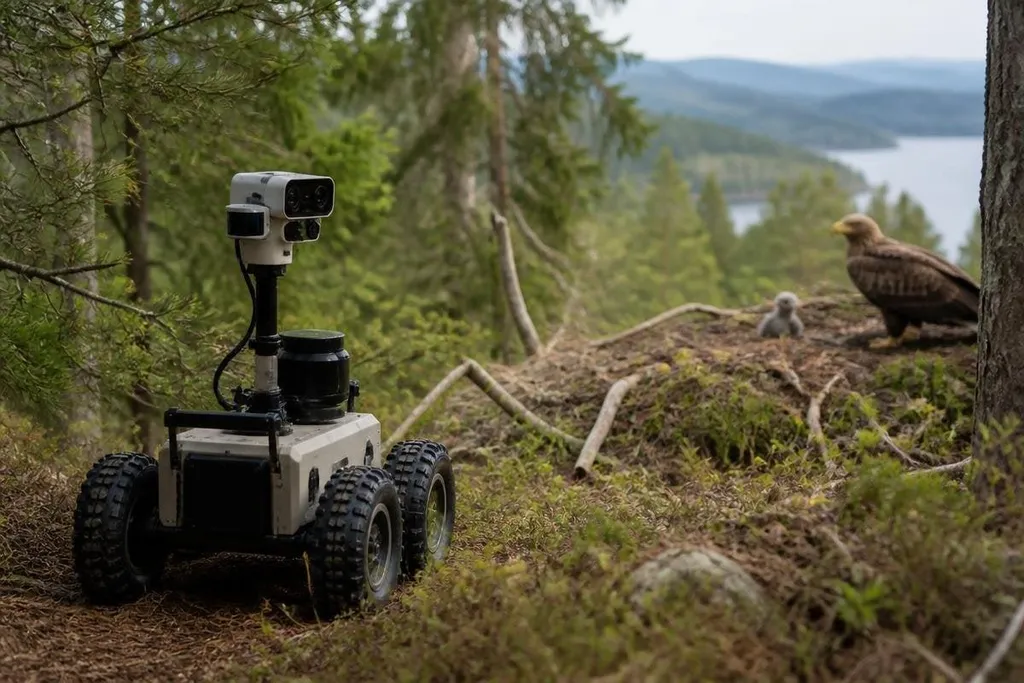
A wildlife robot may spend hours near a nesting site, move through a forest, or inspect a reef without a person beside it. AI helps that robot sort sensor data, choose safe movements, and flag events for a human to check.
For a field team, the useful question is simple: does the software produce better animal records while causing less disturbance?
Quick read
- Cameras and microphones can sort animal signals from background noise.
- Route software can help a robot avoid nests, steep ground, and blocked paths.
- Human review still matters when the system meets an animal or setting it has not seen before.
What AI does on the robot
The robot starts with sensors. A camera records shapes and movement, a microphone picks up calls, and a thermal sensor measures heat. GPS gives the robot its position, while an inertial measurement unit tracks changes in speed and direction.
AI software can compare those inputs with patterns found in its training data. It may mark an image as a possible animal, separate a bird call from wind noise, or flag movement near a route. That first pass cuts the amount of footage a field team needs to review by hand, though the exact result depends on the training data and sensor quality.
The software can also help the robot choose what to do next. A route planner may send it around a fallen tree, slow it near a nesting area, or return it to a charging point when its battery reaches a set level. These are clear tasks with clear limits. The robot follows rules and sensor readings; it does not understand an animal's needs in the way a field biologist does.
Better records, with less disturbance
A person walking into a study area can change animal behavior. A quiet ground robot, a small surface vehicle, or an aerial system can collect data from farther away, depending on the habitat and the study rules.
AI helps after the robot leaves the area. Software can sort images by animal type, time, location, or behavior label. It can also place uncertain images in a review queue instead of treating every result as correct. That matters because a missed animal and a false alarm lead to different field decisions.
The record still needs context. A camera may see an animal but miss its sex, health, or reason for moving. A microphone may detect a call without showing which animal made it. AI can mark the event, while a person checks what the event means.
Wildlife robot reports need the species, habitat, sensor, and date beside each AI result. Wildlife robot reports from Robot24.com can connect those details to the machine and field test, so you can judge what the system saw before the next section looks at where it can fail.
Where the system can fail
Wildlife settings change from one place to another. Leaves can hide an animal, rain can blur a lens, and wind can cover a call. A model trained on clear images may perform poorly in shade or heavy weather.
Power creates another limit. A robot carrying cameras, radios, and onboard computing needs energy for every part of the task.
If it sends raw video over a network, the radio may use more power and require a steady connection. If it processes the video on the robot, the system needs enough computing hardware and battery life for that work.
Animal safety also sets a hard boundary. The system must keep a suitable distance, avoid blocking a path, and stop when its sensors give an uncertain result. Its design should include a human override, clear movement limits, and a way to record when a stop occurred.
The data raises a second set of questions. Wildlife footage can show people, homes, or vehicles near a study area. Teams need rules for storage, access, and deletion before the robot starts collecting images.
A field decision guide
Use this check before choosing an AI wildlife robot for a survey:
- Name the signal: decide if the system must find images, calls, heat, tracks, or movement.
- Check the setting: test shade, rain, rough ground, water, radio range, and plant cover.
- Set the human review rule: send uncertain results to a person instead of forcing a label.
- Measure disturbance: record distance from animals, noise, light, speed, and stop events.
- Plan the data path: set storage, access, retention, and deletion rules before collection.
- Define failure actions: make the robot stop, return, or wait when its sensors disagree.
AI earns its place when it helps a team find useful records without hiding uncertainty. A robot that labels every moving shape may produce more files, but that does not give a biologist better evidence.
I’d choose a system with clear review logs and safe stop rules before one with a longer list of AI features.
The next test is field evidence: how often the robot finds the target animal, how often it raises a false alarm, and how often a person must correct it.